
I recently put together a list of my Top 5 Clint Eastwood Movies. This was a daunting task as I've been watching this stellar performer's films for about as long as I can remember. Additionally, his filmography is jam-packed with quality pictures and narrowing all those worthy candidates down to a Top 5 meant that several wonderful movies (many of which are personal favorites of mine) wouldn't make the cut. I tried to present some variety along the way as this list could have easily boasted nothing but the rugged westerns that this cinema titan is perhaps best known for, and in doing so I wound up making some unconventional choices. Regardless, I think this a worthy list brimming with wonderfully entertaining films, and I'm happy to share my Top 5 Clint Eastwood Movies with you.
Feel free to chime in and let me know how you would rank Clint's cinema exploits and share your thoughts on my choices.
. . .
 | |
I absolutely love both Every Which Way But Loose from 1978 and Any Which Way You Can, the 1980 sequel to that smash hit. Critics loathed these country-western ventures with a heaping side of slapstick humor, but what do they know? Both films fared well at the box office and I'm not alone in my enjoyment of them, though there are many Eastwood fans who didn't enjoy these goofy comedies any more than the critics did. Eastwood mostly plays it cool as Philo Beddoe, a bare-knuckle brawler with a unique family unit, while those around him generate most of the laughs. Some consider Clyde, Philo's beloved orangutan, to be the real star of these movies, and that furry trickster does possess an abundance of charisma. Geoffrey Lewis was terrific as always as Orville, Philo's closest non-simian ally, and Ruth Gordon is a profane and cantankerous delight as Ma. Any Which You Can also benefits from the presence of B-movie icon William Smith, who is perhaps best known as "the dude who played Conan's dad" to my peers. Here, he is cast as a rival bare-knuckle fighter, though he actually helps Clint out for much of the picture and is the first to congratulate him after their epic throwdown brings the picture to a close. Any Which Way You Can is a silly affair that lampoons Clint's tough guy persona, country folk, the police, bikers, and the motel industry, among other things, and it boasts more laughs than uppercuts. It is certainly a departure from Eastwood's typical fare, but the dude was so versatile that he was clearly just as comfortable in the role of Philo Beddoe as he was playing Dirty Harry or The Man With No Name (who had a name in each Leone masterpiece that Clint starred in, but that's a story for another day). I am aware that there are numerous Eastwood vessels that are actually better movies, so I understand why some may not understand why I put Any Which Way You Can on my list. However, if we're looking at Eastwood's filmography in terms of entertainment value, I think the #5 spot on my list is a fitting prize for this lighthearted yarn that is brimming with country music, unique characters, and chuckles.
 | |
| There are a lot of things I love about this movie, but the thing that puts it over the top for me is the presence of the woefully underrated William Smith and the cool relationship that his Jack Wilson and Eastwood's Philo Beddoe enjoy.
. . .
|
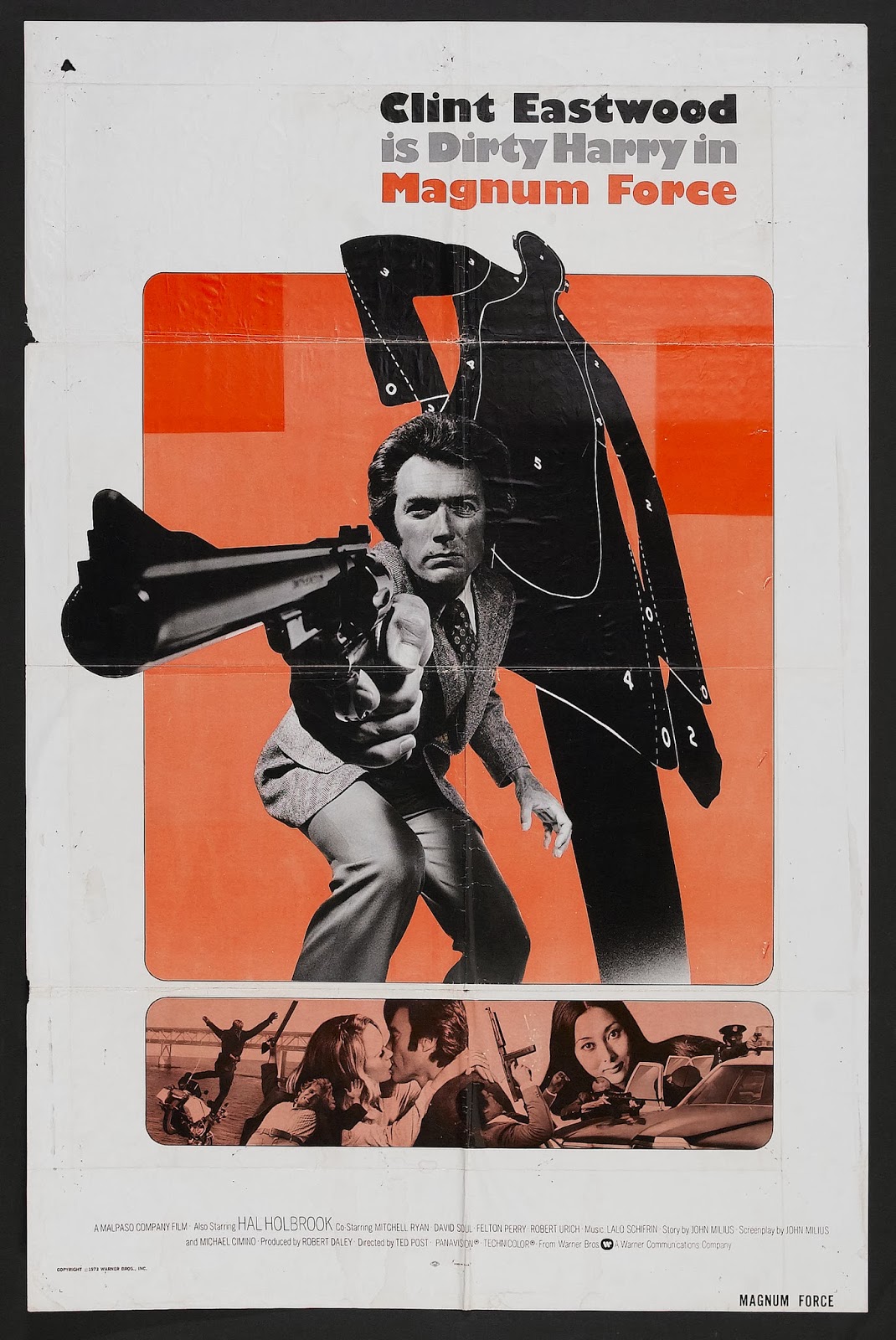
#4) Magnum Force (1973)
Once again, I'm picking a sequel, and this may come as a surprise given the quality of Dirty Harry, Eastwood's first outing as the prickly but lovable Harry Callahan. Hey, I love Dirty Harry. It's a fantastic movie and it introduced us to a legendary tough guy, but Magnum Force is even better. I give a lot of the credit for this noteworthy achievement to John Milius, who came up with a really neat idea for the sequel. What if our maverick lawman, a hero who does things his way, went toe to toe with some hotshot vigilante cops who had taken this approach too far? Michael Cimino helped the mighty Milius turn that curious notion into a riveting screenplay that bolstered this stellar follow-up to one of Eastwood's biggest hits. Hell, throw Hal Holbrook's smarmy Lt. Briggs into the mix, insert some humor and a few nifty setpieces, and the end result is one of Eastwood's best movies, as well as one of those exceptionally rare sequels that somehow manage to outshine the original. Obviously, Clint was a perfect fit for the part of Dirty Harry, and few big screen policeman have been so charismatic or entertaining. Yes, I'm a huge fan of this series. True, things started well with Dirty Harry, reached new heights with Magnum Force, and then gradually began to descend before bottoming out with The Dead Pool in 1988. In the end, it doesn't matter--Dirty Harry is an iconic character in the cinema landscape and he enjoyed two stellar adventures and two solid pictures before that lackluster final entry reared its ugly head. People don't think about The Dead Pool when they think about Dirty Harry; they think about Clint saying "Make my day" or asking some poor punk if he feels lucky. I know there are many of you who prefer Dirty Harry and I understand that picking Magnum Force here will give some of you pause, but it's an easy decision for me. Magnum Force is my favorite Eastwood venture that didn't require him to wear a six-shooter on his hip or dress up in combat fatigues.
 |
| Dirty Harry may be the first time Eastwood portrayed maverick lawman Harry Callahan, but this 1973 sequel is a superior motion picture. In other words, a man has to know his limitations, but a sequel doesn't. |
. . .

#3) Kelly's Heroes (1970)
Like most everyone reading this, I dig Clint's westerns and his gritty thrillers. However, when I put Any Which Way You Can at #5 to start this list, that clearly signified that some of Eastwood's lighter films also rank among my favorites. One such movie that seldom gets its due is Kelly's Heroes, an irreverent gem. Hey, the very notion of a comedic and borderline absurd take on WWII might sound downright blasphemous to some. It should be noted that in addition to poking fun at the establishment and lampooning the military, this one does have a bit of heart, and there are some serious themes buried beneath all the bluster. Eastwood's cool lead (his Kelly may be totally fearless--or maybe he just has a serious hard-on for gold bars) and the fantastic supporting cast never fail to entertain. Telly Savalas is fabulous as Kelly's hard-nosed commander and Don Rickles is equally captivating as Crapgrame. Of course, the true star of the show is Donald Sutherland as Oddball. Yes, the character belongs to another era, but Kelly's Heroes is far more interested in entertainment than plausibility--though it never grows so outlandish that it becomes an outright farce. Purists probably don't favor Kelly's Heroes as much as I do, and modern audiences who are more familiar with films like Saving Private Ryan or Fury (read my scathing review of that one here) may not appreciate this quirky romp either. I like gritty and realistic war movies too, but I may enjoy a quality satire even more. I have no qualms about putting Kelly's Heroes at #3 as I break down my Top 5 Clint Eastwood Movies.
Bonus Points: I find the opening reel to be among the best title sequences of all time. The way the images and the music clash set the stage for something totally unique. It's damn near Tarantino-esque, and the entire score (c/o jazz maestro Lalo Schifrin) is nothing short of wonderful. Additionally, the big tank showdown that closes out the picture is extremely impressive and even takes the satire to another level at one point when the picture playfully pays homage to The Good, the Bad, and the Ugly.
 |
| Sutherland is out of this world as Oddball, and Eastwood nails the part of Kelly, a somewhat dubious and incredibly determined leader of men.
. . .
|

#2) Unforgiven (1992)
When Eastwood rose to fame, he did so by virtue of the western, though he would later prove himself equally adept at other genres. Regardless, when he returned to the western in 1992 with Unforgiven, it's rather fitting that he gave us one of the finest American movies of them all. Poignant, gripping, violent, heartfelt, and exceptionally well-made, Unforgiven is an epic film. The cast is sensational, the plot is riveting, and the cinematography is a joy to behold, though the material and the mood give the picture serious weight. It may not be an easy watch, and it may not be nearly as warm or as hopeful as many of the classic westerns that fans of the genre know and love, but it is a wonderful movie that boasts considerable riches. Eastwood is sheer perfection as William Munny, a retired gunslinger who thought that he had left his wicked ways behind. Morgan Freeman is equally sublime as his pal Ned, while Gene Hackman chews scenery as a sadistic lawman named Little Bill. Richard Harris shines as English Bob and the entire cast does a terrific job of telling this story. The movie is a meditation on many things, to include the thin line between heroism and villainy. It also ponders society's difficult relationship with the truth as opposed to the more palatable myths that we tend to promote. This is surely even more impressive when you take into account that Unforgiven somehow manages to succeed at paying homage to the western while it is also keenly dissecting the genre and shedding new light on many of the most familiar aspects of this beloved portion of the cinema landscape. David Webb Peoples obviously did a tremendous job with the script, and it would have been a crime for anyone other than Eastwood to direct and star in this landmark picture. I don't think it's Eastwood's best film, nor I do think that it is his best western--those honors belong to the movie sitting at #1 on this list. However, if you're one of the many who feel that this is Clint's finest offering, I certainly understand where you're coming from. It really is a stellar movie that boasts one of our most gifted performers at his very best, and few films are as thoughtful or as rewarding as Unforgiven.
 |
| Unforgiven isn't just one of Eastwood's best films, it's a legitimate American classic.
. . .
|

#1) The Good, the Bad, and the Ugly (1966)
There are good movies, there are bad movies, and there are ugly movies. Then there are great movies. I'm talking about epic creations that not only stand the test of time, but often shape the cinema landscape for years to come. One such film is The Good, the Bad, and the Ugly, which many see as master director Sergio Leone's most inspiring accomplishment. Everything works to perfection in this mesmerizing treasure, to include the cast, the iconic score, the wonderful camera work, and the presence of a director with tremendous flair and vision. No one made movies quite like Leone, and with Eastwood, Eli Wallach, and Lee Van Cleef in tow, he provided us with an operatic descent into greed and war that should be experienced by anyone who enjoys movies. The scope and the grandeur of this colorful epic makes it a worthy treat for those willing to trade a few hours of their time for a surreal journey that is blessed with an embarrassment of riches. Chief among those riches is Clint's performance, a case of perfect casting if ever there was one. With The Good, the Bad, and the Ugly, Eastwood emerged as a star, and while he continues to provide us with quality motion pictures, this feast for the senses remains his greatest achievement. This shouldn't come as much of a surprise, for few films aim to be as robust or as magnificent as this one. Of those that strive for such significance, many collapse under their own weight, many arrive as bloated affairs that miss the mark, and only a precious few actually come close to delivering the goods. It is certainly a rare occasion when such a production somehow manages to meet the expectations of those daring souls who saw fit to launch such a venture. The Good, the Bad, and the Ugly is one case where a massive undertaking of this sort actually yielded a glorious success. This was Clint's third film in which he starred for Leone, and for many he will forever remain The Man With No Name. Of course, those who are paying attention will notice that Clint is playing a different character in each of these films and all of these characters have names--so long as we're willing to count "Blondie" as a name in The Good, the Bad, and the Ugly. So perfect is he for these roles that it almost seems as though Eastwood doesn't even have to try to deliver a rousing performance. Yet portraying a character who squints more than he talks surely requires a degree of subtlety and a knack for nuance that is difficult (if not impossible) for many to summon. Eastwood's icy cool demeanor and Leone's vibrant imagination were quite a potent combination, and The Good, the Bad, and the Ugly is one of the best movies ever made. I treasure Clint, and narrowing down his fabulous filmography to 5 movies was daunting, but putting this dazzling masterpiece at #1 was an easy call.
 |
| All three of the westerns that Clint starred in for legendary director Sergio Leone are terrific pictures, but it's The Good, the Bad, and the Ugly that still towers over the genre nearly 50 years after it was originally released. |


